



Lecture 18:Magnetic Levitation (Maglev)
NIDEC Technical Adviser
Takashi Kenjo
Do we humans dream about floating in the air? Let’s break away from the constraints of the universal gravitation, and levitate by using electromagnetic force. It would be interesting to image if we can control such movements.
A new type of magnetic levitation
拙書『図解・わかる電気と電子』(講談社blue backs B249)の最終章(第8章)を磁気浮上にあてました。大学で電子工学を専攻し,卒業研究と修士研究でプラズマ中での電子やイオンの挙動に取り組んだ者として,電子とはいったい何だろうかを考察しながらの執筆でした。電子はスピンに関係し,磁気とは切り離せない性質をもっています。プラズマ研究でのこの類の対処法としては,電子やイオンがガラス管に閉じ込めている状況を3次元空間での数学モデルを頭に描きノートには方程式を記述してみました。しかし,浮揚という場面を想定したことはありませんでした。
自分のテーマをプラズマの中を伝播する波動からモータに切り替えた理由には次の2つあります。
1) ある学会で,プラズマ研究で日本を代表する大先生(後に国会議員)がジャーナリストのインタビューを受けている場面を間近で拝聴していました。この方面のプラズマ研究の大きな流れは核融合発電であることを実感したと同時に,この原子力発電は自分の生涯では実現できそうではないと思いました。強烈な磁界によって高温プラズマを閉じ込めたいのだが,エネルギーの散逸が起きます。例えば不要な波動の発生によるエネルギーが飛散する現象です。そこで,プラズマに発生する波動を何でも調べ尽くそうという考えがあって,所属研究室の教授からいただいた卒論テーマは,イオンの粗密波の解明でした。電子のエネルギーレベルが遷移するときの発光が波として観測されるもので移動縞と呼ばれていました。大先生のインタビューを聴いていたこのとき,波動を抑え込むのではなく,波動現象を有効利用することに関心をもち始めました。
2) 次回で記すのですが,モータの不思議を感じ始めたのは大学3年生のときでした。それは波動とは無関係ではありません。その3年後,ある会社でIT用モータの設計と実験をくり返した後にある決意に至りました。企業でモータの設計や駆動・制御の専門家になるのではなく,実務と実験から得た発想で自分自身のモータ理論を構築しようという自然な決意です。背景には,電子自体が粒子の性質と波動の性質を備えていることが淡いヒントでした。電磁界の波動現象としてモータを捉えようという発想であり,明瞭なのが回転磁界論ですが,それだけでは面白くないことは分かっていました。
It was 27 years ago that I wrote on magnetic levitation for the final chapter of my Japanese book “ Zukai Wakaru Denki to Denshi (Electricity and Electrons) ” (Blue Backs Series B249, Kodansha Ltd.).
What is new now in this science area?
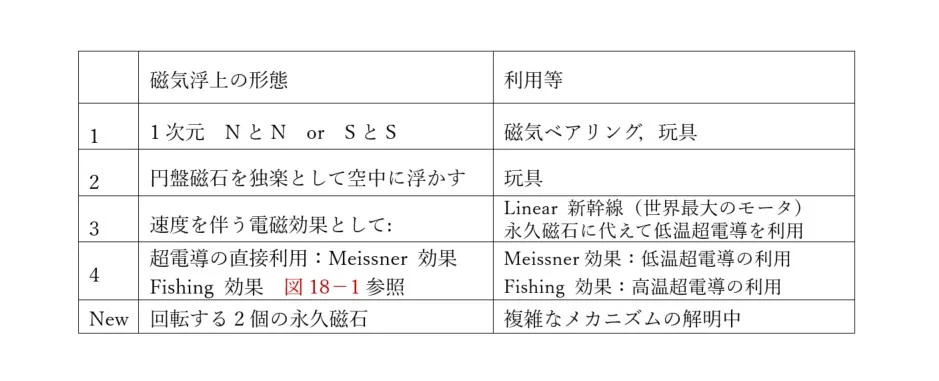
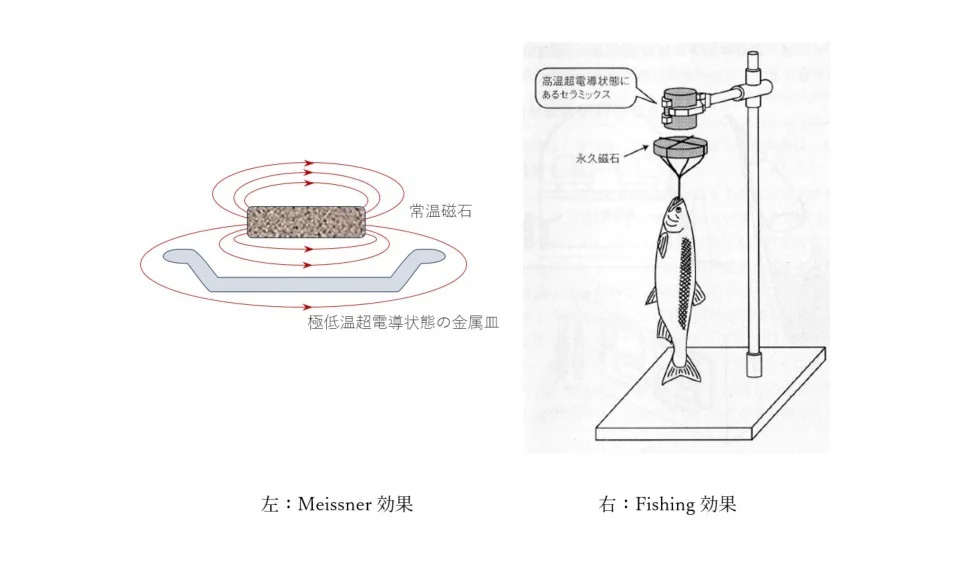
Sections 1-4 of Table 18-1 below are a summary of the main magnetic levitation methods that I explained in this book. The principles and explanations of these methods can be explained with no particular problem. 1) and 2) are applied to toys available online and via other means. The method of using a magnet to levitate another magnet is a technology adopted widely, ranging from toys to maglev trains, leading people to believe that there was little left for further research. 3) is a basic science technology for the planned linear Shinkansen train) whose completion is being delayed. 4) is directly related to superconductivity, the topic I selected for my previous lecture, which focusses on Professor Nakamura of Kyoto University. The “New” section is a matter related to the topic in this lecture.
Floating a spherical permanent magnet
In 2021, Hamdi Ucar of Göksal Aeronautics, in Istanbul, Turkey reported a new type of magnetic levitation [1] , capturing people’s attention. This new levitation is caused by a piece of a fast-rotating permanent magnet, about which others, including Hermansen of the Technical University of Denmark (DTU) in Copenhagen announced a detailed commentary [2] . Based on Ucar’s and other’s viewpoints, physical interpretation and analysis, Hermansen and others made a new proposal, discussing the gap between the rotating axis and the magnetic-pole axis by using a couple of cube-shaped two-pole permanent magnet (a “rotor” and a “floater”). First, Hermansen used two cube-shaped neodymium magnets, to rotate one of them with a drill-like tool, and levitate the other magnet. The magnet seems to have to rotate at its appropriate speed. Hermansen and others discussed levitation in the range of 200-400 Hz (12,000 - 24,000rpm). For this experiment, in addition to these two magnets, we need a drill and a thick aluminum plate. Another document [3] describes that Hermansen used a spherical magnet as a rotor, and extensively researched the sizes of the floater and the rotor, and the relations with the floater’s movement.
We were able to make a spherical floater placed on an aluminum table after some try-and- error. Our experiment procedure is: 1. 1) First, place an aluminum table horizontally on a laboratory table (desk). 2. 2) Put a floater on the aluminum table. 3. 3) Hold the drill and bring the tip of the rotor close to about 7 cm above the floater. 4. 4) Then turn on the switch to start the drill. 5. 5) Next, there are two options. One is to accelerate the drill from low to higher speed gradually. The other option: After adjusting the drill speed around 5000 rpm or so, bring down the drill slowly to the floater. 6. 6) Then, the floater starts to rotate, and, as the round object rotates faster, the floater starts to levitate.
Illustration 18-4 shows the floater levitating at approximately 5,500rpm as its rotating speed increased gradually from 2,000rpm to 5,500rpm. After the floater starts to levitate, and after the drill is tilted, the floater’s location becomes stable on the drill’s rotating axis. It is interesting that the axis’ rotating speed is much lower than in Ucar’s case (105,000rpm).
What high-speed rotation means
We were able to make a spherical floater placed on an aluminum table after some try-and- error.
Our experiment procedure is:
1. 1) First, place an aluminum table horizontally on a laboratory table (desk).:
2. 2) Put a floater on the aluminum table.:
3. 3) Hold the drill and bring the tip of the rotor close to about 7 cm above the floater.:
4. 4) Then turn on the switch to start the drill.
5. 5) Next, there are two options. One is to accelerate the drill from low to higher speed gradually.
The other option: After adjusting the drill speed around 5000 rpm or so, bring down the drill
slowly to the floater.
6. 6) Then, the floater starts to rotate, and, as the round object rotates faster, the floater starts
to levitate.
References
- [1] H. Ucar, “Polarity free magnetic repulsion and magnetic bound state,” Symmetry 13, 442 (2021).
- [2] J. M. Hermansen et al ., “Magnetic levitation by rotation,” Phys. Rev. Appl. 20, 044036
- [3] J. M. Hermansen, “How Rotation Drives Magnetic Levitation,” October 13, 2023• Physics 16, 177