



Coupling
A coupling is a device used to connect two shafts together at their ends for the purpose of transmitting power, torque, or motion. The primary purpose of couplings is to join two pieces of rotating equipment while permitting some degree of misalignment or end movement or both.
Couplings are commonly used to join the shaft of the motor to that of the driven load.
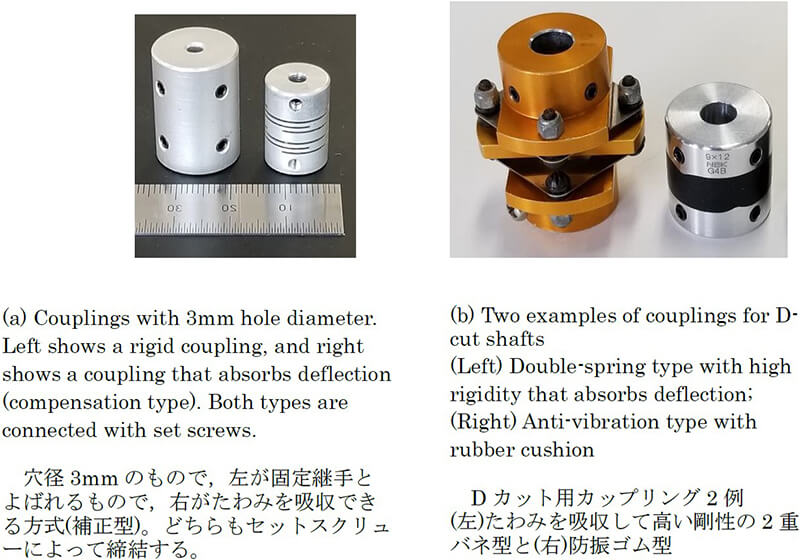
Rigid couplings, also called muff or sleeve couplings, consist of cylindrical sleeves, such as the one shown in Fig. (a), and are the simplest type of coupling. However, they are not used very often because the shafts of the motor and driven load must be axially aligned and kept parallel accurately. Couplings for small motors with outputs of several hundred watts are usually made from aluminum rods or aluminum die-castings, although zinc die-castings and fiber-reinforced engineering plastics are used as well. Meanwhile, large couplings are usually made from steel or cast steel. Flexible couplings often use elastomeric inserts, of spring steel plates or rubber, to absorb axial misalignment (eccentricity) or angular misalignment (declination).
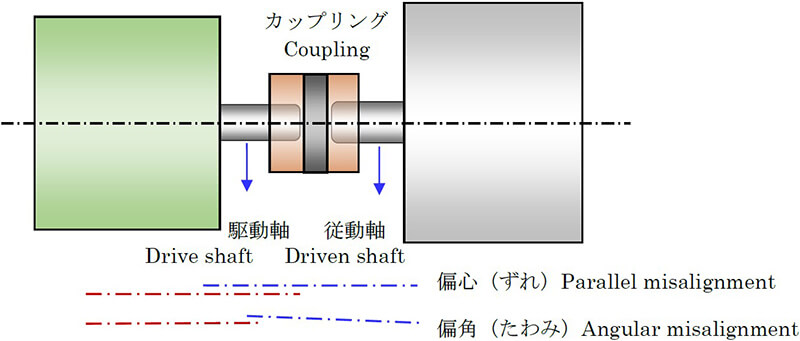
Coupling: couples two machines while absorbing the (parallel an d angular ) misalignment s of the shafts to transmit rotational angle and torque. Various types of couplings exist to meet different requirements in the accuracy of rotational angle or the upper limit of transmitted torque.
Term List (C)
 Capacitor-run motor
- Carbon brush
- Circulating current
- Coercive force, coercive intensity
- Cogging torque
- Commutation
- Commutator
- Concave and Convex
- Concentrated winding
- Concentric winding
- Concentricity
- Conductor
- Consequent pole
- Constant-power characteristics
- Construction of a DC motor
- Continuity of magnetic fields
- Cooling methods
- Copper machine
- Core
- Coreless motor
- Coulomb friction
- Coupling
- Cylindrical motor