
G/Governance
Corporate Governance
Basic stance
The purpose of the corporate governance of the Nidec Group is to become a conscientious and principled company that earns society’s trust and to increase our corporate value sustainably. To this end, we maintain and enhance our internal control, thereby running our business more healthily and efficiently. Furthermore, we disclose
information appropriately to increase the transparency of the Company’s business operations. We are also committed to ensuring the independence and diversity of the Board of Directors by taking into
account, among others, the balance of the knowledge, experience and qualifications of the Board of Directors as a whole and the number of its members, based on its diversity in gender, career history,
age, etc. and on Nidec’s business scale.
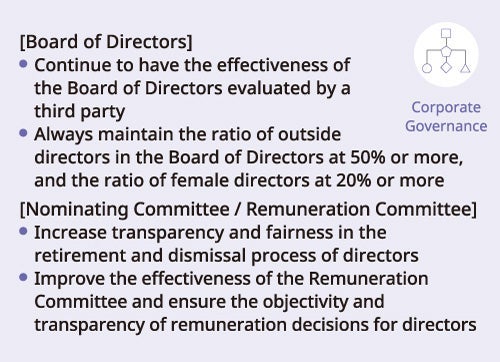
In order to ensure the effectiveness of the Board of Directors’ Meeting, it is important to incorporate a new perspective with independence and objectivity from a third party. If a third party perspective
is not introduced, there is a risk that the function of the Board of Directors’ Meeting will not improve or may even slow down. In addition, if the effectiveness of the Nomination Committee and
Remuneration Committee is not improved and fairness, transparency and objectivity are not ensured, we recognize that this will have a significant impact on the loss of public trust due to legal
and compliance violations, as well as on the improvement of corporate value and the sustainability of management.
Based on the understanding that corporate governance is one of the highest-priority issues for our sustainable growth and medium- to long-term improvement in corporate value, we will make efforts to
enhance the relevant systems.
Target
Materiality
Systems and actions
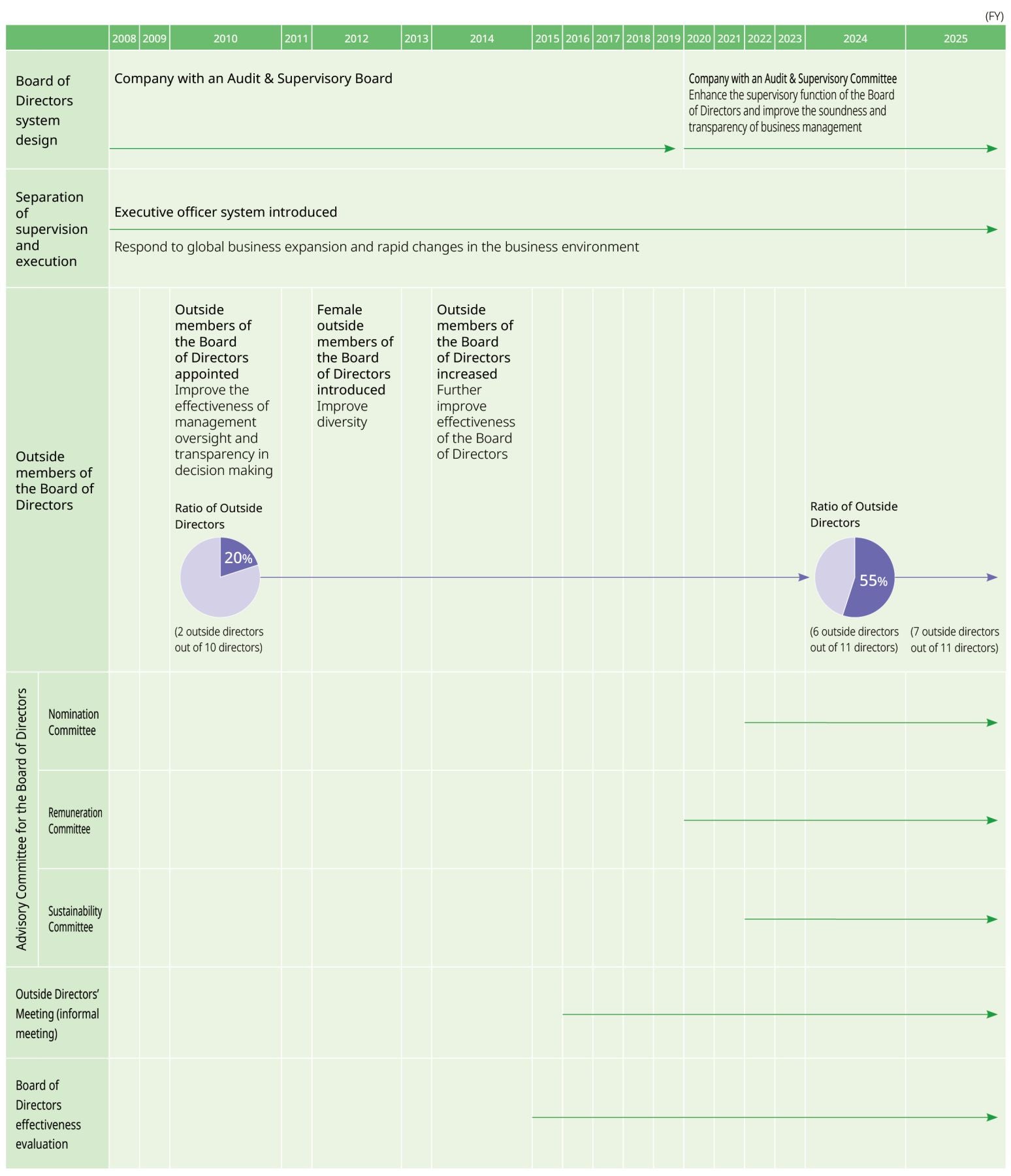
History of Nidec’s corporate governance
➊Board of Directors
The Board of Directors makes material management decisions and oversees the Group’s business operations as a whole. The Board of Directors includes highly independent Outside Members, to enhance the supervisory function of the company’s business operation and improve management transparency and objectivity. The Board of Directors consists of 13 directors, 5 of whom are outside directors.
Skills matrix
Areas of Expertise and Experience Expected of Directors (up to four)
| Name | Legal Affairs and Compli ance |
Financ e and Accoun ting |
Gover nance and Risk Manag ement |
Corpor ate Manag ement Experi ence |
Knowl edge of Capita l Marke ts |
Busine ss Strate gy |
Techno logy and Resear ch & Develo pmen |
Intern ation al Perspe ctive and Global Experi ence |
Huma n Capita l and Diversi ty |
Enviro nment al and Social Matter s |
|---|---|---|---|---|---|---|---|---|---|---|
| Mitsuya Kishida | ◯ | ◯ | ◯ | ◯ | ||||||
| Masayuki Minai | ◯ | ◯ | ◯ | ◯ | ||||||
| Takeshi Miyake | ◯ | ◯ | ◯ | ◯ | ||||||
| Akitsugu Era | ◯ | ◯ | ◯ | ◯ | ||||||
| Shinichi Koizumi | ◯ | ◯ | ◯ | ◯ | ||||||
| Soichiro Sakuma | ◯ | ◯ | ◯ | ◯ | ||||||
| Yuji Nishiura | ◯ | ◯ | ◯ | ◯ | ||||||
| Ryoichi Yamamoto | ◯ | ◯ | ◯ | ◯ | ||||||
| Hiroshi Yoshii | ◯ | ◯ | ◯ | ◯ | ||||||
| Takeshi Yamazaki | ◯ | ◯ | ◯ | ◯ | ||||||
| Hideki Amano | ◯ | ◯ | ◯ | ◯ | ||||||
| Misawa Kishinami | ◯ | ◯ | ◯ | ◯ | ||||||
| Mitsuhiro Hasegawa | ◯ | ◯ | ◯ | ◯ |
➋Audit and Supervisory Committee
The Audit and Supervisory Committee audits the execution of duties by the Board of Directors’ members, and receives audit reports from the Accounting Auditor.
Composition of members and the chairperson
|
Total committee
members |
Full-time members |
Internal Members of the
Board of Directors |
Outside Members of the
Board of Directors |
Chairperson | |
|---|---|---|---|---|---|
| Composition | 5 | 2 | 0 | 5 |
Outside member
of the Board of Directors |
Cooperation between the Audit and Supervisory Committee and accounting auditors
In addition to quarterly meetings, the Audit and Supervisory Committee and the accounting auditors meet about eight times a year whenever necessary. In these meetings, they exchange information and opinions on audit results, audit systems, audit plans, audit implementation status and the like.
Cooperation between the Audit and Supervisory Committee and the internal audit department
The Corporate Administration & Internal Audit Department, Nidec’s internal audit department, regularly hold meetings with the Audit and Supervisory Committee to report on the results of the Nidec Group’s internal audits. In addition, the Audit and Supervisory Committee exchanges opinions and shares information with the Corporate Administration & Internal Audit Department as necessary, and requests the Corporate Administration & Internal Audit Department to conduct on-site audits.
➌Nomination Committee
The committee is headed by Ryoichi Yamamoto, an outside member of the Board of Directors, and consists of five outside members of the Board of Directors. The committee deliberates on matters such as the policy and criteria for the selection of directors and executive officers, as well as succession plans and ideas for the selection of candidates for the positions of directors, president and executive vice presidents.
➍Remuneration Committee
The committee is headed by Yuji Nishiura, outside member of the Board of Directors, and consists of five outside members of the Board of Directors. The committee deliberates on matters such as the formulation of remuneration decision policies related to executive remuneration, and the design of remuneration systems (establishment of performance targets, the rationality of performance-linked remuneration, the appropriateness of remuneration structure, and individual remuneration amounts based on remuneration systems).
Policies on remuneration for Members of the Board of Directors
1. Basic policy
The remuneration for Nidec’s directors is determined based on the following policy, to enhance the company’s global competitiveness and secure the sustainable growth of its businesses.
- Increase motivation toward improving corporate value;
- Contribute to securing talented managerial human resources; and
- Ensure that the level of the remuneration is appropriate for the scale and area of Nidec’s businesses.
2. Composition of the remuneration
-
Outside Members of the Board of Directors (excluding those who are members of the Audit and Supervisory Committee)
Fixed remuneration -
Members of the Board of Directors (excluding those who are Outside Members of the Board of Directors and members of the Audit and Supervisory Committee)
Fixed remuneration : Variable remuneration (bonuses) : Performance-linked share-based remuneration = 3:1.5:1
| Remuneration type | Description | Payment method |
|---|---|---|
| Fixed remuneration |
|
Monthly in cash |
|
Variable
remuneration (bonuses) |
|
Monthly in cash |
|
Performance-linked
share-based remuneration |
|
After three fiscal years
(shares and money) |
Reflecting ESG targets in performance-linked compensation for directors
From 2024, a performance-linked coefficient will be incorporated into the performance-linked share-based remuneration for directors (excluding the Founder and Chairman of the Board, outside members of the Board of Directors, and directors who are members of the Audit, etc. Committee) in accordance with the degree of achievement of performance targets in a single fiscal year, etc. The degree of achievement of ESG targets will be determined based on the ESG rating or score of the Company by MSCI, FTSE, and CDP, and will be reflected in the performance-linked coefficient.

3. Procedure to decide the remuneration amounts
The amounts of fixed and variable remunerations for individual directors (excluding members of the Board of Directors who are members of the Audit and Supervisory Committee) are determined by the Board of Directors based on reports submitted by the Remuneration Committee, which is a voluntary advisory body, in accordance with the criteria specified by this policy. Similarly, the details of the performance-linked share-based remuneration are determined by the Board of Directors based on reports submitted by the Remuneration Committee.
FY2024 total amount of remuneration by category of directors and by type of remuneration, and the number of eligible directors
| Category |
Total amount of
remuneration (million yen) |
Total amount by type of remuneration (million yen) |
Number
of eligible persons |
|||
|---|---|---|---|---|---|---|
|
Fixed
remuneration |
Variable
remuneration |
Performance-linked
remuneration |
Retirement
benefits |
|||
| Members of the Board of Directors (excluding those who are members of the Audit and Supervisory Committee and outside members of the Board of Directors) | 171 | 176 | - | △5 | - | 3 |
| Audit and Supervisory Committee members (excluding outside members of the Board of Directors) | 40 | 40 | - | - | - | 2 |
| Outside directors | 60 | 60 | - | - | - | 7 |
*1 Introduction of the performance-linked share-based compensation plan for Members of the Board of Directors, etc. was resolved at the 45th Regular General Meeting of Shareholders held on June 20, 2018. The aforementioned amounts are the amounts recorded as expenses in this fiscal year based on Japanese GAAP. Outside Members of the Board of Directors are not covered by this plan.
*2 As the amount of performance-linked share-based remuneration finalized in this fiscal year fell below the cumulative remuneration amount calculated at the end of the previous fiscal year, the difference is shown as a reduction in the above table.
4. Forfeiture, etc. of remuneration (clawback/malus)
Fixed and variable remuneration may be reduced with the consent of the relevant person if he or she has caused serious damage to the Company. In addition, if a person eligible for performance-linked share-based remuneration commits a serious violation of their duties, breaches internal rules, or engages in other misconduct after the vesting of beneficiary rights, the company may claim the return of the remuneration from that person.
❺Sustainability Committee
The Sustainability Committee is headed by Akitsugu Era, Outside Member of the Board of Directors and consists of two internal members and four outside members of the Board of Directors. It oversees business operations related to sustainability and reports to the Board of Directors. The Sustainability Committee meets two or more times in fiscal year.
❻Various committees
| Name | Description |
|---|---|
| Information Security Committee | The Information Security Committee is placed under the Board of Directors to formulate basic policies concerning information security, as well as to monitor the status of implementation of various information security measures and provide instructions. |
| Compliance Committee | The Compliance Committee is placed under the Board of Directors to discuss and decide basic compliance policies and measures, as well as to monitor the status of implementation of various compliance measures and provide instructions for improvement. The Compliance Committee meets once every three months. |
| Risk Management Committee | The Risk Management Committee is placed under the Board of Directors and chaired by the executive officer in charge of risk management. The Committee decides risk management policies and measures and submits reports and proposals to the Board of Directors. It also monitors the company-wide risk management status and constantly reviews the adequacy of allocation of resources necessary for risk management. Based on the annual policies established by the Risk Management Committee, department general managers in charge of risk management and Group companies formulate and carry out their respective annual risk management plans. |
❼Monthly Executive Meeting
The Monthly Executive Meeting is a meeting where the CEO and all the other executives gather to discuss high-priority issues to ensure that all executives share the same level of understanding on the Nidec Group’s direction.
❽Executive Management Meeting
The Executive Management Meeting is held twice a month and, as the decision-making body for the execution of business, it deliberates on matters to be discussed at the Board of Directors’ Meeting and important management issues in advance.
Support systems for Outside Members of the Board of Directors
The General Affairs and Sustainability Promotion Department, which acts as the secretariat for the Board of Directors, supports the Outside Members of the Board of Directors. The General Affairs and
Sustainability Promotion Department provides the outside directors with the company’s information in a timely manner, and corresponds to their inquiries through day-to-day communication. With regard to
the meetings of the Board of Directors, the General Affairs and Sustainability Promotion Department provides all members of the Board of Directors with materials related to the proposals for the meetings
and accounting information, at the latest one day before the day of the meeting. In addition, assistance is provided by the Corporate Administration & Internal Audit Department, Nidec’s internal audit
department, to Outside Members of the Board of Directors who are Audit and Supervisory Committee Members. When a meeting of the Audit and Supervisory Committee is held, meeting notices are sent out to all
the Audit and Supervisory Committee Members by three days prior to the day of the meeting, while documents related to the proposals to be deliberated in the meeting of the Audit and Supervisory Committee
are sent to the members, at the latest one day before the meeting. After a meeting of the Audit and Supervisory Committee, meeting minutes are sent to all Audit and Supervisory Committee Members.
Furthermore, for Outside Members of the Board of Directors who are Audit and Supervisory Committee Members, various information is reported and provided as necessary by fulltime Audit and Supervisory
Committee Members and Nidec’s executive officers.
Outside members of the Board of Directors who are not members of the Audit and Supervisory Committee have informal meetings with the Audit and Supervisory Committee members, where various information is
provided by Nidec’s executive officers. They also conduct on-site inspections of the business sites and group company in Japan, in person or online.
Internal control
Basic stance
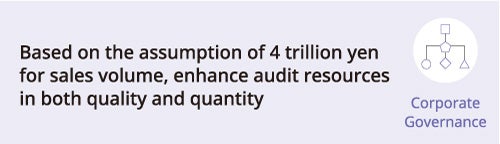
The Nidec Group commits itself to enhancing its management soundness and transparency by establishing a compliance system generally required of a listed company in Japan, and clarifying its risk management responsibilities. Specifically, through the auditing activities of the Corporate Administration & Internal Audit Department, the Group aims to maintain and improve the effectiveness of its internal control over financial reporting required by Article 24-4-4, Paragraph 1 of the Financial Instruments and Exchange Act. In addition, the Legal & Compliance Department, the Risk Management Committee, and the Information Security Committee are organized under the Board of Directors, under which the Legal & Compliance Department, the Risk Management Office, and the Information System Department, are placed as the secretariat respectively, working to create a corporate culture and enhance management systems for internal control.
Target
Materiality
Actions
Nidec Group companies’ corporate governance
Nidec Group companies act based on the Nidec Corporation’s business philosophies and policies, and are part of the Nidec Corporation’s internal control system. Nidec Corporation dispatches and seconds its executives and employees to its consolidated subsidiaries. The companies respectively consider the opinions of experts and others, and discuss sufficiently before making executive decisions based on each company’s situation, to secure its independency.
Cross-shareholding
Policy for cross-shareholding
Nidec holds shares in the companies that Nidec has relationships with in terms of trading and cooperation in its business and other areas, when it judges that such shareholding contributes to the company’s corporate value expansion through stabilization of its business from a medium-to-long-term perspective by maintaining and strengthening its relationship with those companies. Nidec assesses its cross-held shares individually at the Board of Directors meeting every year, on not only qualitative aspects such as the purpose of the shareholding, but also on quantitative aspects such as the benefits that can accrue through the shareholding from the perspective of economic rationality. According to the results of the assessment, Nidec intends to reduce the number of shares it holds if the cross-held shares are not expected to bring significant benefits.
Criteria for exercising voting rights for cross-shareholding
With regard to the exercise of voting rights in relation to cross-shareholdings, Nidec makes comprehensive decisions to vote for or against individual proposals to serve the investees’ sustainable growth from the perspective of whether appropriate governance and compliance structures are in place at investee companies.
(Basic views on exercising voting rights)
With regard to the individual proposals submitted to the shareholders’ meetings of the companies Nidec invests in, Nidec decides to vote for or against after confirming the following points: whether the
proposals suit the purposes of the shareholding which are to maintain and strengthen the trade and cooperation relationships through medium-to-long- term investment; and particularly, whether there are
any circumstances that might lead to undermining of the shareholders’ value due to the restructuring of organizations, including asset transfer and mergers. Nidec opposes all proposals that are considered
to violate the law or constitute antisocial behavior, in all circumstances.