
Materiality
Materiality Initiatives
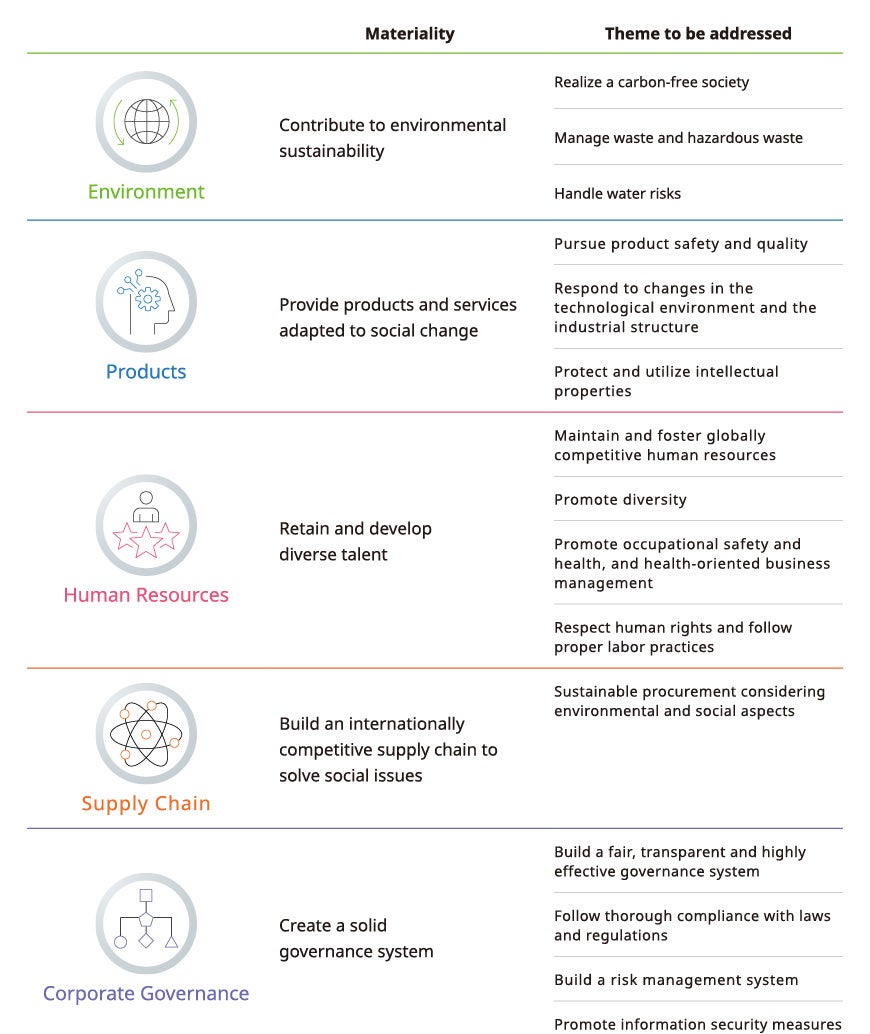
To ensure effective and steady implementation of our materiality initiatives, Nidec has set 15 action themes in the five materiality categories. And, for each theme, we have set KPIs, which we intend to
achieve by FY2025. We may change the materiality issues, action themes and KPIs taking into consideration their validity according to the business environment in the future.
As a structure to check that each activity is being conducted steadily and effectively, a Sustainability Promotion Meeting is held periodically. In this meeting, held every other month in principle, its
participants check the status of the execution of materiality-related business operations, and deliberate and resolve policies and important matters related to Nidec’s sustainability activities.
Materiality and theme to be addressed
KPIs for each themes to be addressed
| Category | Materiality |
Theme to be
addressed |
Sub-theme | KPI (FY2025) | Progress in FY2024 |
|---|---|---|---|---|---|
| Environment |
Contribute to
environmental sustainability |
Realize a
carbon-free society |
Contribute to
decarbonization through products |
Contributing through Automotive Products
Contributing through the small precision motors
|
[Contributing through Automotive Products]
As for the EV traction motor system (E-Axle), since the production of unprofitable models was reduced from the second half of FY2023, the number of units shipped decreased, resulting in a downward trend in CO₂ emission reductions through to FY2024. [Contributing through the small precision motors] The amount of CO₂ emissions reduced by the supply of drive motors for e-bikes in FY2024 remained at 6,500 t-CO₂, mainly due to the fact that the speed of market growth did not reach the level forecasted when the KPI was established. |
|
Reduce
GHGs emissions attributable to business activities |
|
With the aim of increasing the renewable energy introduction ratio, we promoted initiatives with a focus on both energy-saving and renewable energy introduction. In FY2024, the renewable energy introduction ratio increased to 13.6%, thanks to initiatives such as the in-house development of electricity consumption visualization system at the Nidec Center for Production Technology R&D and the introduction of the Group’s first off-site PPA. In addition, we initiated an internal carbon pricing system. Regarding the TCFD Recommendations, based on the results of a business impact assessment, we further strengthened our decarbonization efforts (considering the introduction of an internal system to strengthen and promote energy-saving and renewable energy introduction) and implemented measures to reduce water risks. | |||
|
Manage
waste and hazardous waste |
ー |
|
We conducted waste reduction activities with a focus on iron and aluminum. In FY2024, the amount of waste generated decreased by 12.0% compared to FY2022. | ||
|
Handle
water risks |
ー |
|
We conducted water risk assessments that were more in line with the actual situation of each site through detailed analysis of local information and water usage at the target site and interviews. We completed water risk assessments by confirming the results of detailed analyses of the sites identified as having high water risks and that measures to address water risks were being taken at these sites. | ||
| Products |
Provide
products and services adapted to social change |
Pursue
product safety and quality |
ー |
|
The Small Platform Motor & Solutions Business Unit adopted low-lead materials for 11 new models, achieving a reduction of 315 kg of lead compared to conventional materials. The Automotive Motor & Electronic Control Business Unit continued to conduct audits of project deliverables. It also analyzed trouble cases and compiled root causes and countermeasures into a database to use for design quality checks. With the appointment of a CQO, the Global Quality Management Division established a structure in which the General Manager of the Division oversees the heads of the quality assurance departments of all NIDEC Group companies. |
|
Respond
to changes in the technological environment and the industrial structure |
ー |
|
Based on the "Five Business Pillars," new business areas of focus for the medium to long term, we vigorously promoted product development and technological innovations that will contribute to solving social issues, with a focus on CO₂ reduction. We also strategically pursued environmental contribution and value creation by promoting LCA-based CO₂ emissions calculation and indicator setting. | ||
|
Protect
and utilize intellectual properties |
ー |
|
We worked to build and manage IP portfolios that match each stage of the product lifecycle and to utilize these rights. We also formulated an intellectual property action plan together with the business heads of each of the Five Business Pillars, and conducted regular evaluation of activities. | ||
|
Human
Resources |
Retain and
develop diverse talent |
Maintain
and foster globally competitive human resources |
ー |
|
We established the Global HR Strategy Committee. We promoted the discovery of talented individuals, regardless of nationality or geographic location, and built a globally common system for formulating succession plans. In addition, we incorporated the Human Resources Development Committee into the management meeting structure to ensure that management executives discuss strategic human resources development and personnel allocation. |
|
Promote
diversity |
ー |
|
We conducted diversity dialogue sessions between outside directors and employees, cross-organizational/regional global interactive workshops, and an overseas site-originated mentoring program for female employees. We also conducted an organizational performance survey, and held workplace workshops to encourage members of each workplace to hold discussions based on the survey results. | ||
|
Promote
occupational safety and health, and healthoriented business management |
ー |
|
Regarding occupational safety and health, we conducted comprehensive inspections on "internal equipment safety mechanisms (848 cases) and forklift safety measures (2,703 cases)." As part of efforts to promote health and productivity management, we held health seminars by industrial physicians to improve employees' health literacy. For employees with high health risks, we provided individual health guidance and encouraged them to receive a thorough medical examination, in order to improve and maintain the health of all employees. | ||
|
Respect
human rights and follow proper labor practices |
ー |
Follow proper labor practices
Respect human rights
|
We micromanaged the working hours of employees and properly reported them to and cooperated with relevant parties. Regarding the human rights due diligence process, we placed focus on human rights impact assessments, and the cessation, prevention, and mitigation of negative impacts. We clarified our human rights impact assessment plans and decided to conduct risk identification and assessments with a particular focus on the Southeast Asian region. We also began collecting information through interviews with the sites in that region and other methods to improve the accuracy of risk assessments. | ||
|
Supply
Chain |
Build an
internationally competitive supply chain to solve social issues |
Sustainable
procurement considering environmental and social aspects |
ー |
|
We updated the “Nidec Group Supply Chain CSR Promotion Guidebook.” In addition, we visited suppliers with high human rights risks identified in the previous fiscal year's NIDEC Supplier CSR Self-Assessment, and conducted on-site interviews and began discussions to address issues. |
|
Corporate
Governance |
Create
a solid governance system |
Build a fair,
transparent and highly effective governance system |
Board of
Directors |
|
To ensure the effectiveness of the Board of Directors, we conducted an annual questionnaire survey of all Board members, including outside directors, and a third-party evaluation (by an external law firm). The Board of Directors’ performance of its supervisory function was highly evaluated again in FY2024. |
|
Nominating
Committee / Remuneration Committee |
|
The Nomination Committee, an advisory body to the Board of Directors, began deliberations for the selection of candidates for the next president. Regarding executive remuneration, a proposal was submitted to the Board of Directors to establish a system that links performance-linked executive remuneration to ESG performance. | |||
|
Management
and enforcement of internal control |
Based on the assumption of 4 trillion yen for sales volume, enhance audit resources in both quality and quantity | We promoted efforts to improve and streamline internal audit operations. We strengthened the on-site self-audit system at all Group sites and the monitoring of consolidated financial figures using DX technology, with the aim of preventing errors in financial reporting, identifying risk areas, and deepening audit procedures. | |||
|
Follow
thorough compliance with laws and regulations |
ー |
|
We strengthened face-to-face compliance seminars. Instructors visited multiple sites, including Group companies, to hold two-way discussions with employees in order to prevent compliance violations. | ||
|
Build a risk
management system |
ー |
|
We reviewed and re-identified items subject to risk assessment and worked to improve the efficiency of risk assessment activities. The re-identified risk items were evaluated to determine priority risks requiring immediate action. | ||
|
Promote
information security measures |
ー |
|
Following the cyber-attack incident, we conducted an investigation to understand the details of the incident and identify causes, and submitted a report/notification to the competent authority and contacted all relevant parties. We also instructed all sites in the Group to conduct emergency security inspections and make necessary corrections in order to prevent recurrence of damage. |